How ShareChat & Moj revamped search recommendations for Bharat ke users ki khoj 🔎

Monica Jeshnani10 Jul, 2023


This blog describes the highlights of our year-long journey of how the team at ShareChat continuously made iterations to help our 400mn+ multilingual users discover a wide variety of content (images, videos, creators, hashtag content etc.) via search recommendations.
ShareChat platform witnesses billions of searches throughout the year. With great demand comes greater responsibility to surpass the expectations of our searching users since searching users have better retention (4pp) on our platform. It’s important to organise information and present content in a way that makes sense to our 400Mn+ multilingual users on ShareChat & Moj. In our attempt to make search more natural and intuitive, we are on a path to make search results relevant with fewer characters typed by our users. The vision of ShareChat Search is to help our multilingual users find diverse content to consume, even if they don’t have the right words to describe what they are looking for or have no idea what keyword they want to search for.
Let’s go to the drawing board.
Challenge 1 - 91.8% of searching users on our platform are passive searchers (users with < 60 searches per year). The primary cause for this challenge is that multilingual users may not know ‘what to look for’ or ‘how to use search to consume desired content.’
Challenge 2 - Power users' top searches on our platform are limited to common keywords like ‘good morning’, ‘WhatsApp status’, ‘love’ etc. Users end up doing repeat searches and consuming content related to these common keywords, but they miss out on exploring the breadth of content available on our platform.
Challenge 3 - Search relevance on ShareChat is a massive AI/ML problem given millions of new pieces of content get created every day and in many different formats like images, videos, and text, so mapping a search query to relevant content is a challenge since we have limited levers to scan millions of documents in elastic search
How did we solve the challenges?
At ShareChat, we swear by the first principles problem-solving approach, breaking down complex problems into foundational elements that can be reassembled. The search experience can be visualized as a 3 step journey after the user has viewed the search bar on the home or explore the screens of the app. So the foundational elements of search are -
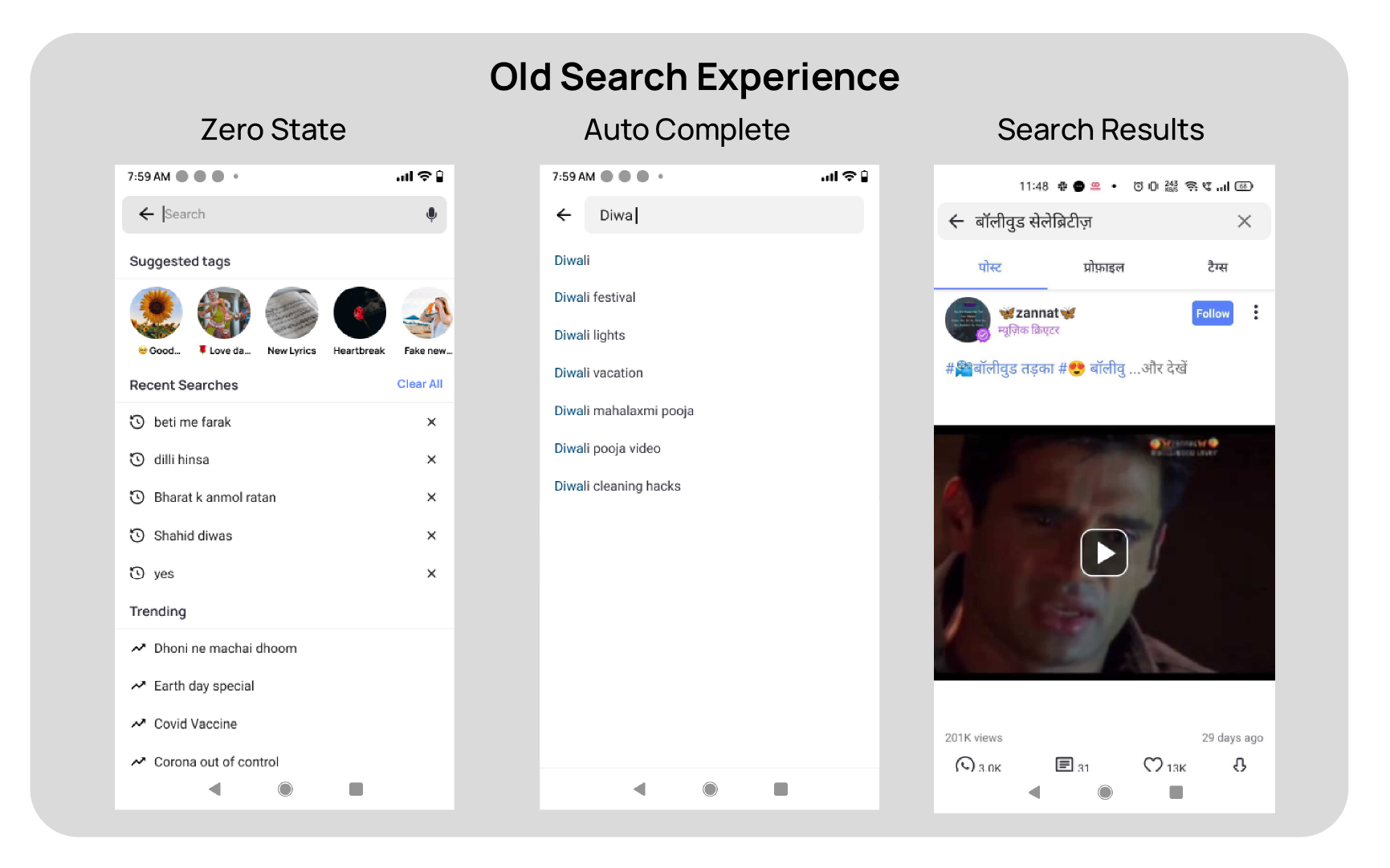
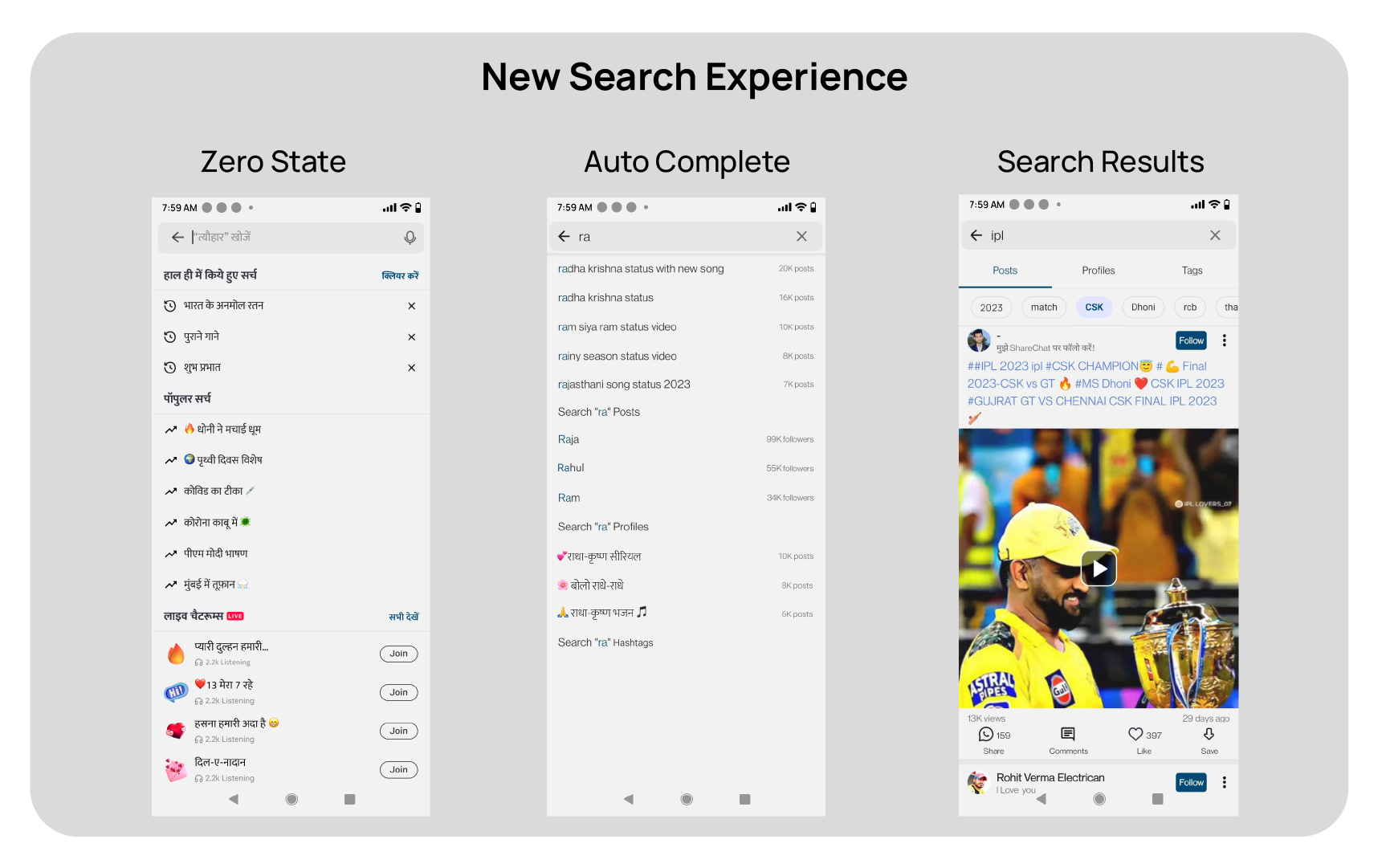
- Search zero page - Users tap on the search bar but do not start typing
- Autocomplete page - Users start typing, and based on characters typed by them, we provide autocomplete suggestions matching their query
- Search results page (SRP) - Multi-model search results relevant to the user’s search query presented as posts (images, video), creators or user profiles and content tags
To address the first challenge (i.e. helping users to inspire what to search), we launched illustrations in the search bars to nudge users with diverse keyword suggestions from major categories. These were personalised language-wise so that users feel motivated by relatable suggestions such as ‘bhangra’ for Punjabi, ‘Mysore palace’ for Kannada users, and ‘Ollywood’ for Odia language users, respectively.
The second challenge (i.e. helping users explore the breadth of content) required a nuanced approach since it’s driven by the habit of our users who come to our platform regularly to find shareable content for common scenarios such as ‘WhatsApp status’, ‘good morning’ etc. These power users usually repeat searches from the ‘recently searched’ section of zero state; however, we wanted to familiarise these users with other platform-wide content. So we restructured our Zero state as follows :
Zero state (ZS) = Section catering to personal user demand (Recent search) + Platform-wide popular demand (Popular search) + Platform supply-based suggestions depending upon genre affinity of users (Search suggestions for you)
Zero state revamp proved to be a game changer for enhancing search experience, and we observed over 10% gain in the ‘ZS searched/search open users’ metric in due course of the year. We also observed improvement in the quality of search keywords. Furthermore, to improve the discovery of live chat rooms on our platform, we took our zero-state recommendations to the next level by merging popular search and genre affinity suggestions for you sections into one and showing chat room suggestions as a new section which provides chat room suggestions relevant to the genre affinity of searching users, and this feature helped us in improving the discovery of chat rooms as well as paving the way for our searching users to become paid consumers of live chat rooms.
After solving for users in zero state, the next step of the funnel was to improve the autocomplete suggestions users get once they start typing.
This brings us to tackle challenges #2 and #3 mentioned above. Initially, our autocomplete supported prefix-matched query suggestions. We took this a notch above by facilitating hashtag and profile suggestions in autocomplete to help users discover content as well as creators and hashtags to foster stronger network-led consumption and creation. We also iterated to reduce search latency, i.e. time taken to render search results using multiple candidate generation, which is the first stage of recommendation.
Given a query, the system generates a set of relevant candidates and refined ranking logic to refine search results and also powered tag search to facilitate search results for concatenated tags, translations & transliterations for hashtags in 15 languages to ensure high-quality suggestions for our multilingual audience. These combined efforts led to reducing typed searches from 30.5% to 22.7% on ShareChat and from 60% to 45% on Moj, hence helping users quickly land on the content they are looking for.
Our quest to create a refined experience for our searchers also extends to helping users explore the breadth of content available on our platform across all languages. This was made possible by launching ‘Guided search’ on the results page. So if a user types for ‘navratri’ query in the search box, they will see search guides or keyword suggestions similar to navratri, such as ‘dandiya’, ‘durga’, ‘festival’, ‘garba’ etc., which provide users with a wide range of options so that they can have additional context and make choices as they search content. This also helps users narrow search results or explore diverse content relevant to their search intent. Over 70% of our search users who were shown guides interacted with guides, and on the platform level, we have improved our % interacted per session metric by over 5%.
We have just started to transform our search experience. In the year ahead, we hope to make our recommendations more personalised and contextual for our multilingual users because that’s where the potential to appeal to the interests of our next billion internet users lies.
We are hiring!
At ShareChat, we believe in keeping our Bharat users entertained in their language of preference. We are revolutionizing how India consumes content and the best in class technology is at the forefront of this transformation. In addition, you'll also get the opportunity to work on some of the most complex problems at scale while creating an impact on the broader content creation ecosystem.
Exciting? You can check out various open roles here!
Illustration: Haritha NV